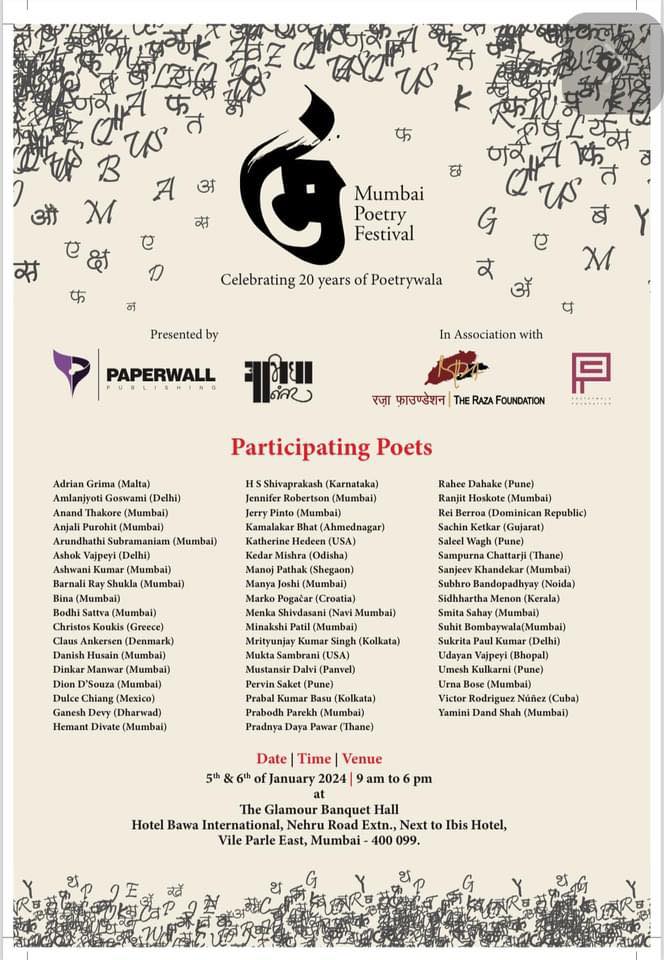
In January 2024 I was invited to Mumbai to take part in the 2024 edition of the Mumbai Poetry Festival organised by Poetrywala Foundation in association with Paperwall Publishing and The Raza Foundation to celebrate 20 years of the celebrated poetry imprint Poetrywala.
While at the Festival I also had the pleasure to talk to the Maltese High Commissioner in New Delhi, H. E. Reuben Gauci. (More about that and the fascination connections of the global village below.)
Poetrywala has published more than 150 poetry collections including many collected and selected works of pathbreaking poets from more than 30 world languages translated into English. “For us, poetry publishing is a non-profit activity. It is a movement. We feel that poetry needs to change with the times, or else we will write the same things over and over again.”
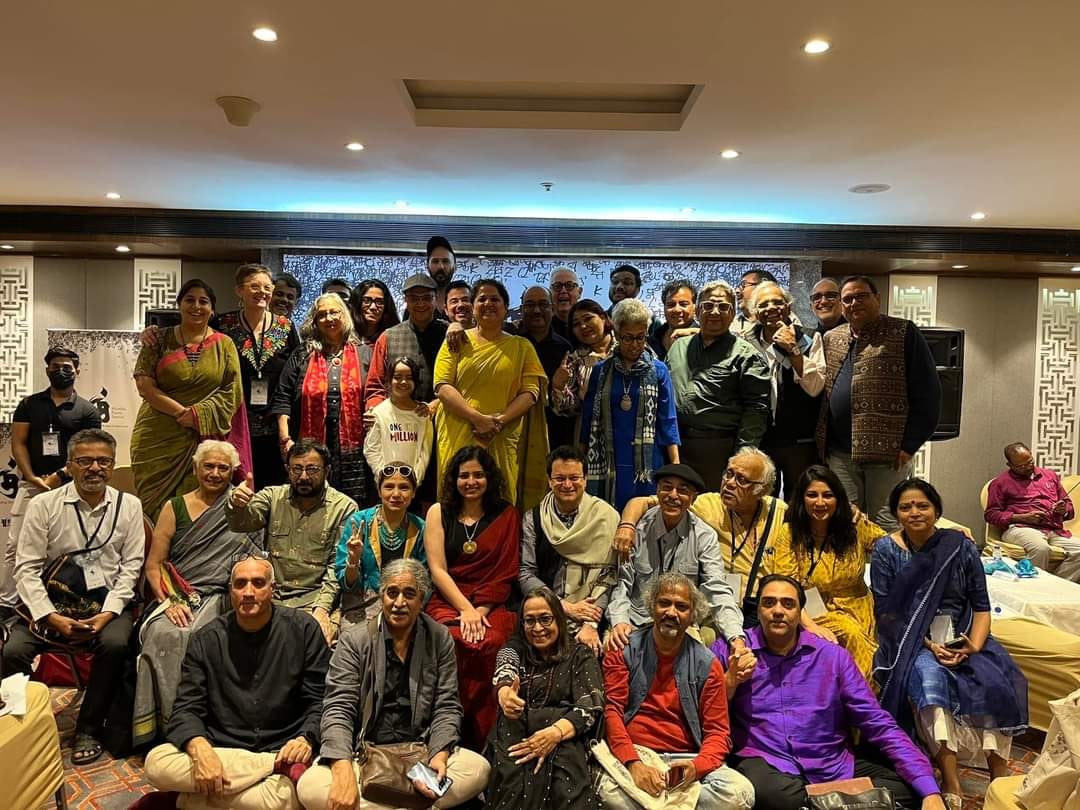
The Mumbai Poetry Festival 2024 was a celebration of the written and spoken word. It brought together poets, writers, translators and academics from across the globe to present their work, engage in collegial discussions and celebrate the richness and power of poetry.
As a featured poet I had the opportunity to share my work, and connect with fellow poets, writers and translators from India and beyond, as well as an appreciative and enthusiastic audience of poetry lovers.
Over the two days of the Festival, I was involved in three events:
- the launch of Prabal Kumar Basu’s book of poems In Search of Silence followed by readings by a number of poetry, including myself;
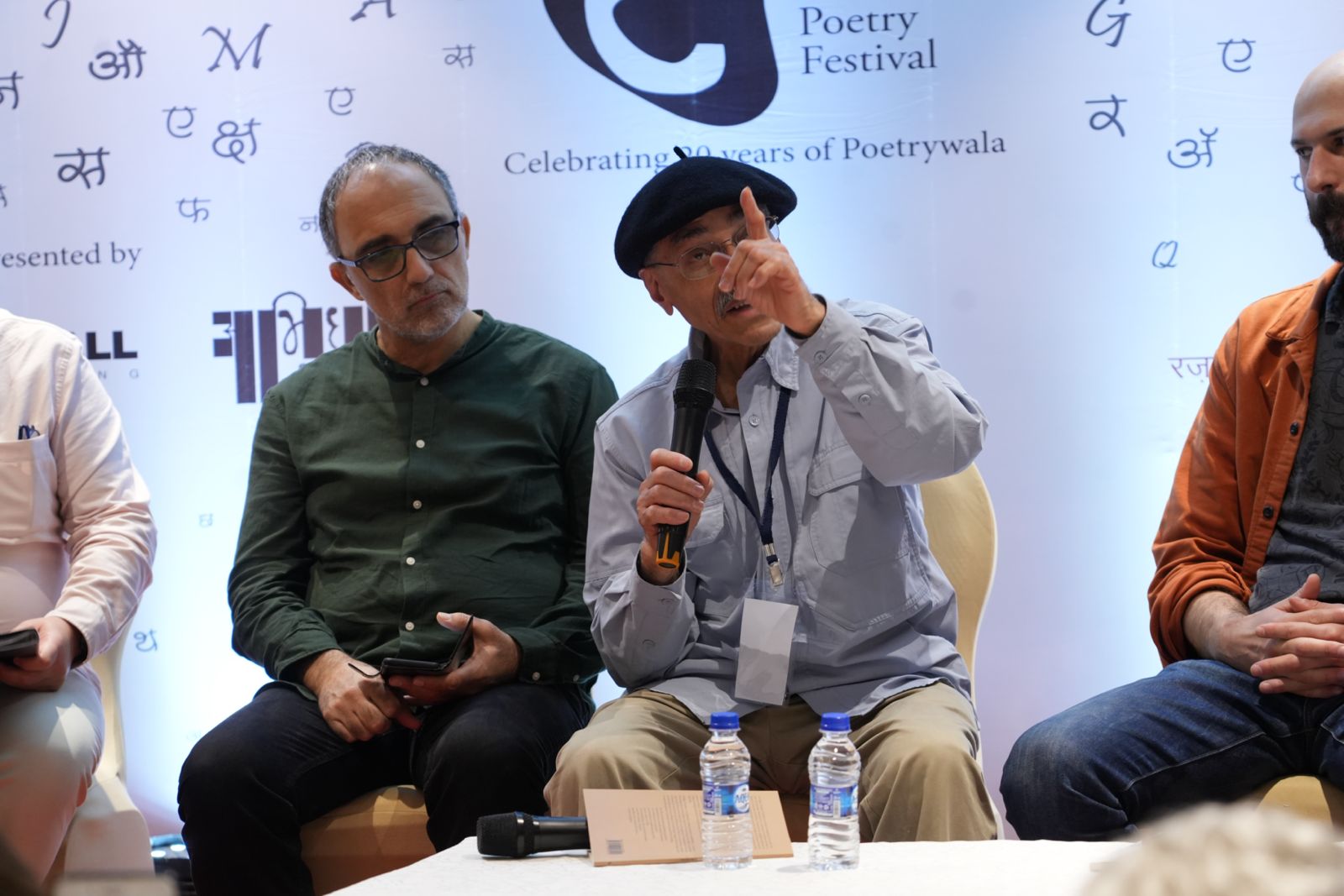
- a discussion on “Maltese Poetry Today” with Adrian Grima and Sampurna Chattarji, which also featured the presentation of the collection Between Seas by Elizabeth Grech, translated by Irene Mangion;
- “Words are the only jewel I possess,” a reading by non-Indian poets of one of their poems in their original languages.
Special thanks to Poetrywala Foundation, and in particular to Hemant Divate, Smruti Divate, Vaishali Narkar, and Sanjeev Khandekar.

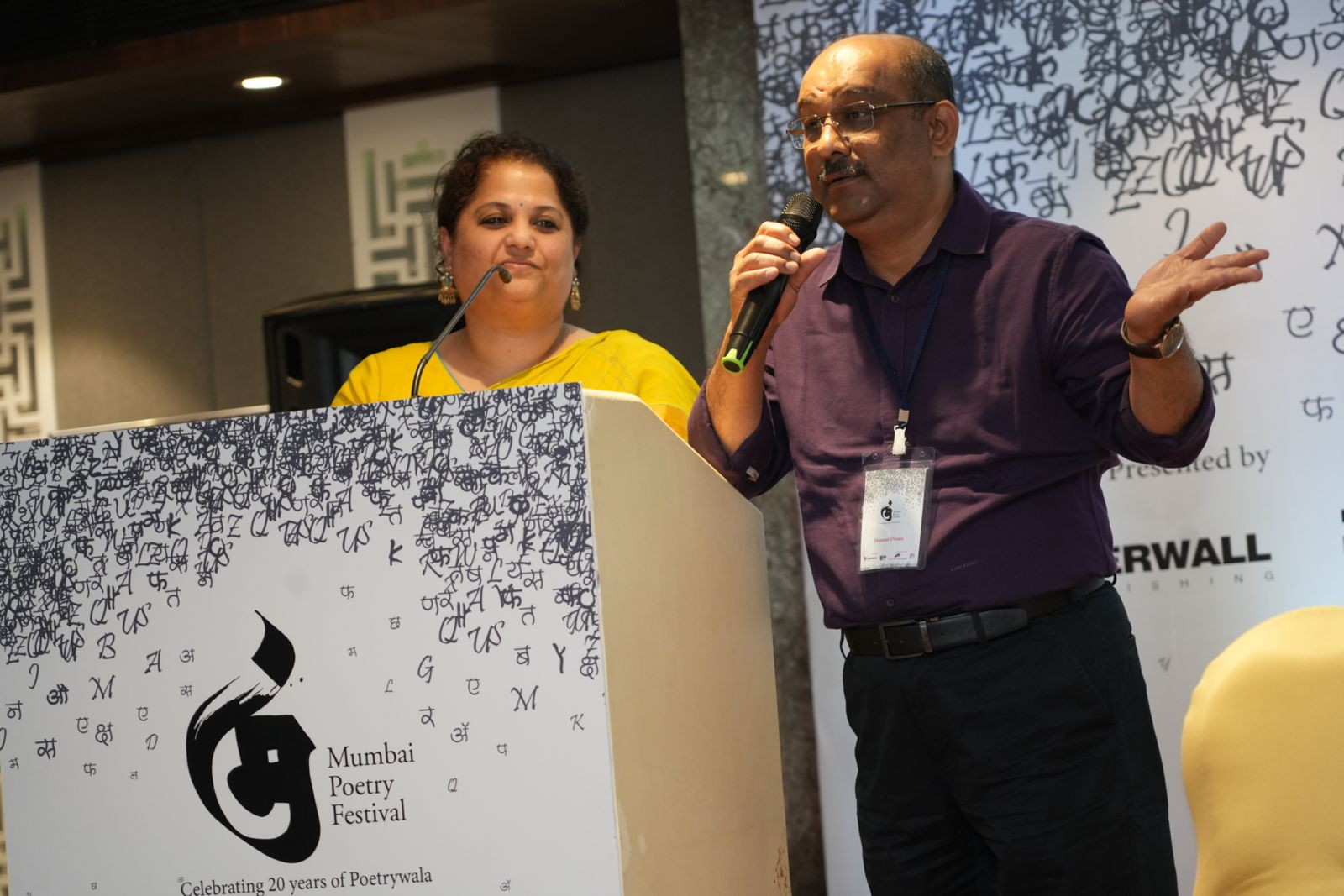
Ashok Vajpeyi, Inaugural Address: Poetry and Freedom

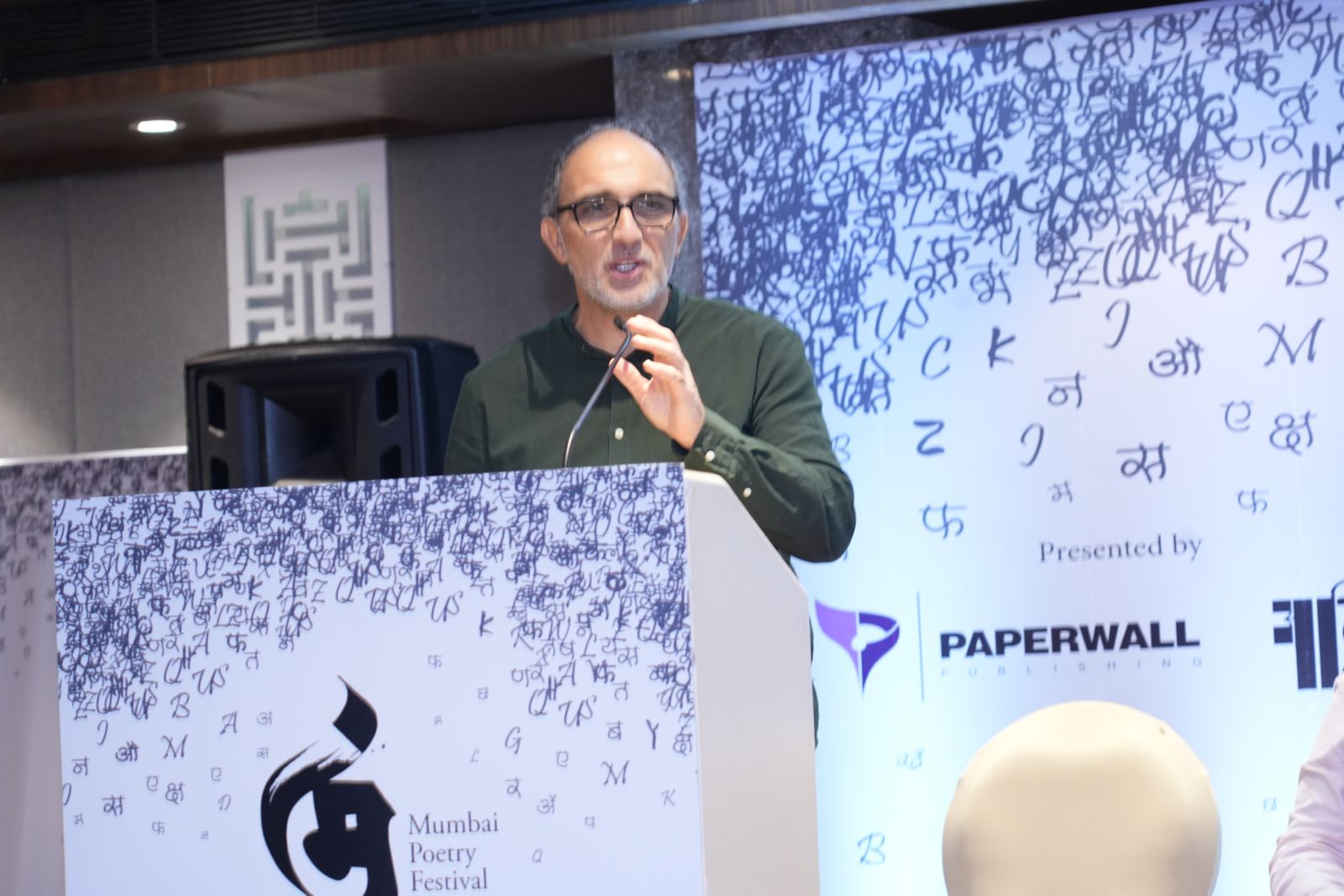
The inaugural address of the Festival was given by Ashok Vajpeyi, the celebrated Indian Hindi-language poet, essayist, literary-cultural critic, and noted cultural and arts administrator. When I first visited India as part of a literary tour organized by Literature Across Frontiers in 2016, I had the good fortune of coming across a collection of his poetry translated into English by Rahul Soni, who I had the pleasure to meet in person and have dinner with. The book, A Name for Every Leaf: Selected Poems, 1959-2015 (HarperPerennial 2016), continues to be one of my favourites.
Ashok Vajpeyi began his inaugural address on “Poetry and Freedom” at the #MumbaiPoetryFestival by mentioning war in #Ukraine & genocide in #Gaza and referring to how “we are meeting in dark times.”
He talked about how freedom for poets is both a condition and an aspiration.
It is a condition without which their attempt to create a republic of
imagination, to dream of alternatives against the given cannot succeed,
sometimes cannot even move at all.Freedom is an aspiration because no where in our world total freedom
ashok vajpeyi
is available or even possible. There may be fragmentary freedom
possible but the missing fragments may be disastrously absent
restricting freedom. There may be political and legal freedom but no
economic freedom; there may be economic freedom but under severe
political restrictions. There may be many freedoms but no spiritual
freedom or freedom for free thinking. The poets cannot wish these
situations away and must live and work under them struggling to find
a way cut to enlarging freedom.
Ashok Vajpeyi talked about how our times have been described as ‘post truth’ times. Truth, he said is under assault from all sides. He suggested that this might be an an unprecedented situation in history.
Lies never had such opportunities, technologies and human support of intelligence and surveillance to spread fast: they displace, surround, over-whelm, marginaliz truth. Sometimes one feels that the world lives more by lies than by truth; the world changes faster by lies than by truth. The poets and writers, on the other hand, stick to truth. They continue to imagine, to make fiction of, to assert the presence of truth. Unlike politicians, idealogues, technocrats, they fabricate lies to reveal truth. One of the severe constraints of our times is that the freedom to speak, explore, interrogate truth by poets and writers is getting narrow and many a time go unnoticed. It may indeed be an illusion that readers and the society need to know truth as poets believe!
ashok vajpeyi
Towards the end of his address, Vajpeyi reiterated that poetry is a determined force “against simplification, uniformity and totalization. In times of growing
tyrannical tendencies, it is almost civil disobedience.” While “truth is not exclusive, if at all, to poetry,” there is “no poem which does not engage with truth.”
On the second day of the Festival, Ganesh Devi delivered the second keynote address.
Release of Prabal Kumar Basu’s book of poems – In Search of Silence
After the celebratory release of Prabal Kumar Basu’s book of poems In Search of Silence, there were poetry readings by Prabal Kumar Basu hismelf, H S Shivaprakash, Bodhi Sattva, Menka Shivdasani, and myself. The moderator of this session was the poet, novelist, festival curator, and poetry editor Pervin Saket.


In this session, I read three poems from my collection Last-ditch Ecstasy (2017), with translations by Albert Gatt, published in Malta by Midsea Books and in India by Poetrywala in Mumbai. My poems started with war (“What will you do when night comes to an end?”), to the passing of my father (“Seventy years of bruising”), and bruised love (“A cobalt shudder of sky”).


Maltese Poetry Today at the Mumbai Poetry Festival
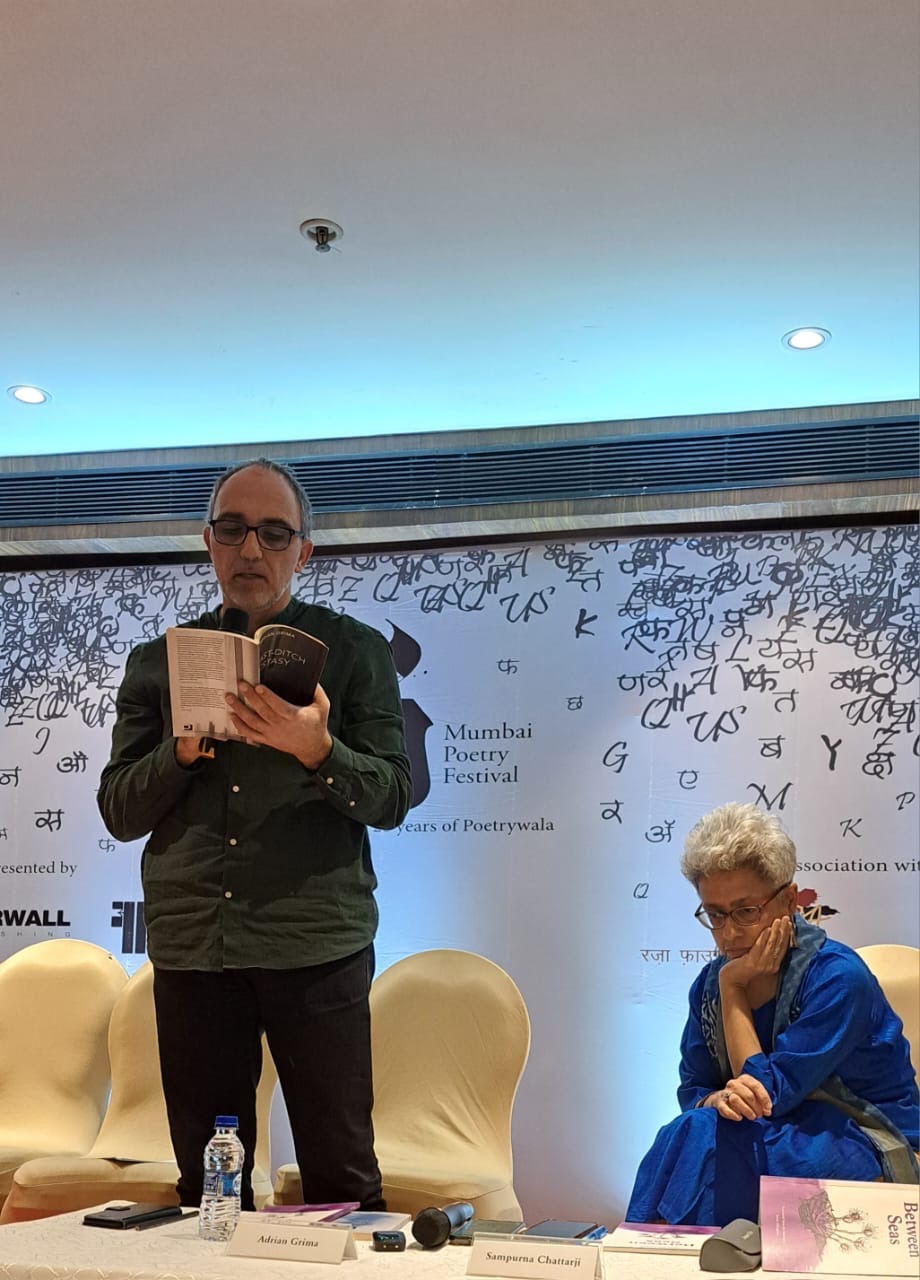
In a session on “Maltese Poetry Today,” I was interviewed by Sampurna Chattarji about the Maltese language, the history of its poetry, the political decision of choosing to write in Maltese, and the poetry that is being written today. The session started off with the presentation of the collection Between Seas by Elizabeth Grech, most of which were translated by Irene Mangion, and published by Poetrywala (2023). The poems were originally written in Maltese and were published in Bejn Baħar u Baħar (Merlin Publishers, 20..). Sampurna read the poem “Autumn,” translated by Albert Gatt, and I read the original version in Maltese, “Il-Ħarifa.”
During the session I read “Your Deciphered Lips” and “Love is Caprice” from my book, Last-Ditch Ecstasy (Midsea and Poetrywala, 2017), with translations by Albert Gatt. When I introduced “Love is Caprice” I talked about how Maltese allows for sentences without verbs, as in the case of “L-Imħabba l-Kapriċċ,” and how this poem was in important exercise for me in breaking standard Maltese to reconstruct it as poetry. But I also talked about how we write as part of a tradition and often we are revisiting that tradition even when we are doing our best to steer clear of it.


Pictures below taken by the poets Prabal Kumar and Sanjeev Khandekar.



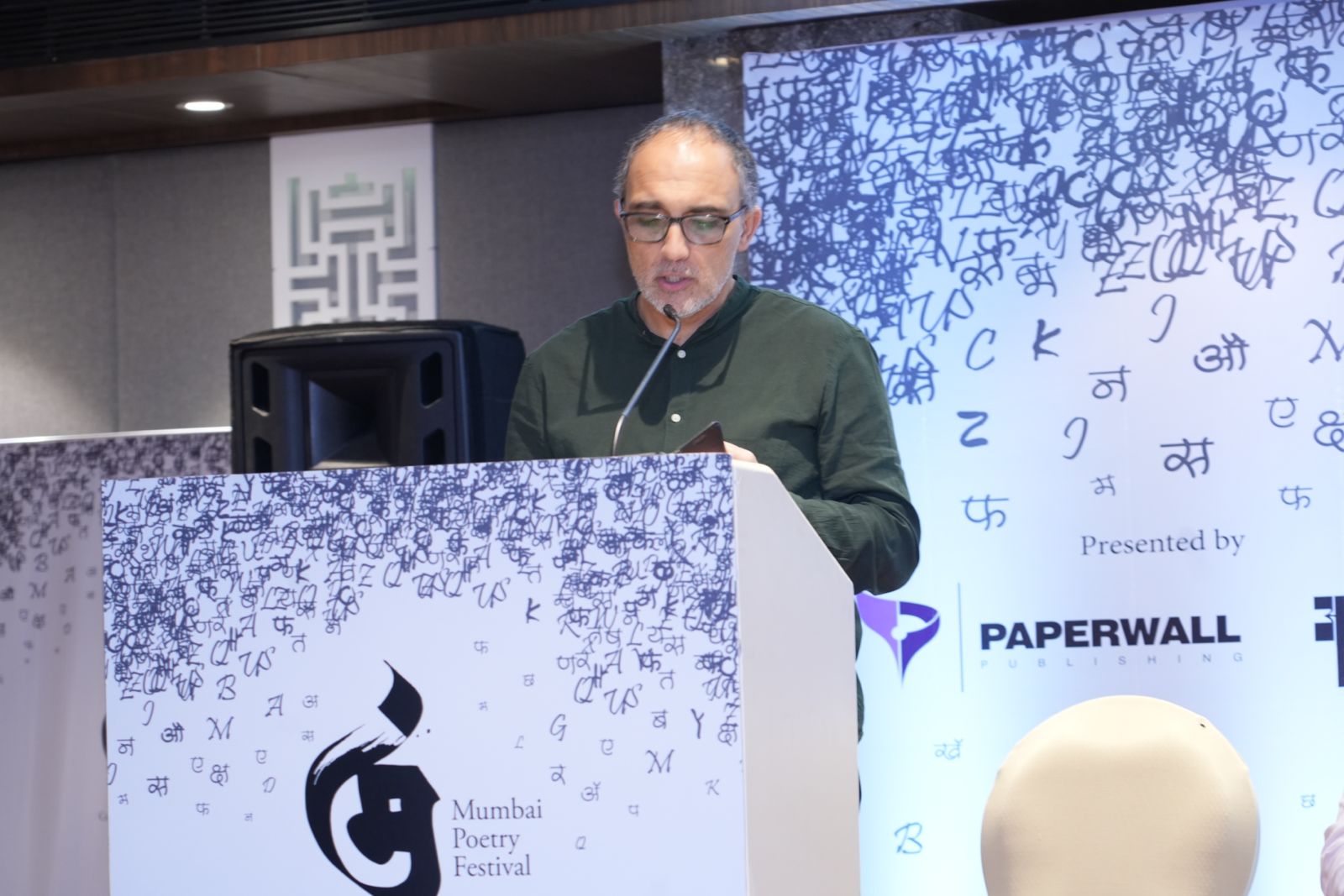
“Words are the only jewel I possess”
“Words are the only jewel I possess,” a reading by non-Indian poets of one of their poems in their original languages. The other poets were Víctor Rodríguez Núñez (Cuba, USA), Katherine Hedeen (USA), Dulce Chiang (Mexico), Marko Pogačar (Croatia), Rei Berroa (Dominican Republic, USA), and Christos Koukis (Greece). The poem I read in this session was “Għajnejk l-Alġier” (“Your Eyes Algiers”).



Tribute to Bombay poet Nissim Ezekiel
We are celebrating Ezekiel’s centenary in 2024. Created by The Hyphenbrands/Prasanna Sankhe on the occasion of Mumbai Poetry Festival, celebrating 20 years of Poetrywala.
Nissim’s poem is read by Sampurna Chattarji, Mustansir Dalvi and Jerry Pinto.
Reuben Gauci is with Adrian Grima in India
7 January 2024, 13:09
While I was in Mumbai to attend the Mumbai Poetry Festival I also had the honour and the pleasure to talk to the Maltese High Commissioner in New Delhi, H. E. Reuben Gauci.
I talked about the festival, the contacts that began in 2016 through Inizjamed and Literature Across Frontiers, and the publication of my poems and those of Elizabeth Grech by Poetrywala. I also talked about the role of poetry and literature in general and the powerful Indian voices I was privileged to be listening to during the two-day festival

My pleasure to speak to renowned Maltese Writer and Academic, Prof Adrian Grima who is currently participating in the Mumbai Poetry Festival, in Mumbai, India. I wish I could have travelled to Mumbai from New Delhi to meet Prof Grima personally, but unfortunately that was not possible.
Nevertheless getting in touch with Prof Grima, is always inspiring!
H. E. Reuben Gauci
High Commissioner Gauci spoke at length about Malta’s ties with India, especially those of the Maltese Jesuits with the Santali tribe. Over the years, the Official Development Assistance Fund of the Ministry for Foreign and European Affairs and Trade of the Republic of Malta has provided assistance to the wonderful work being done by Marcette Buttigieg.
“Thanks for the call, High Commissioner Reuben Gauci. Always such a pleasure. Thanks for the great work you do to represent Malta.”
adrian grima
I was thrilled to learn from High Commissioner Gauci that Marcette Buttigieg is the sister of one of my Ph.D supervisors, the internationally acclaimed scholar of Gramsci, Prof. Joseph A. Buttigieg, who at the time was Professor of English Literature at Notre Dame University, Indiana, in the US. Sadly, both my supervisors, Prof. Buttigieg and Prof. Oliver Friggieri, have now passed away.

 adriangrima.org