Complementing the conference ‘Hésitation et Création‘, a soirée poétique – ‘Poetry and hesitation’, was held on the evening of 6th May 2024 in the Oliver Friggieri of the Valletta Design Cluster in Valletta.


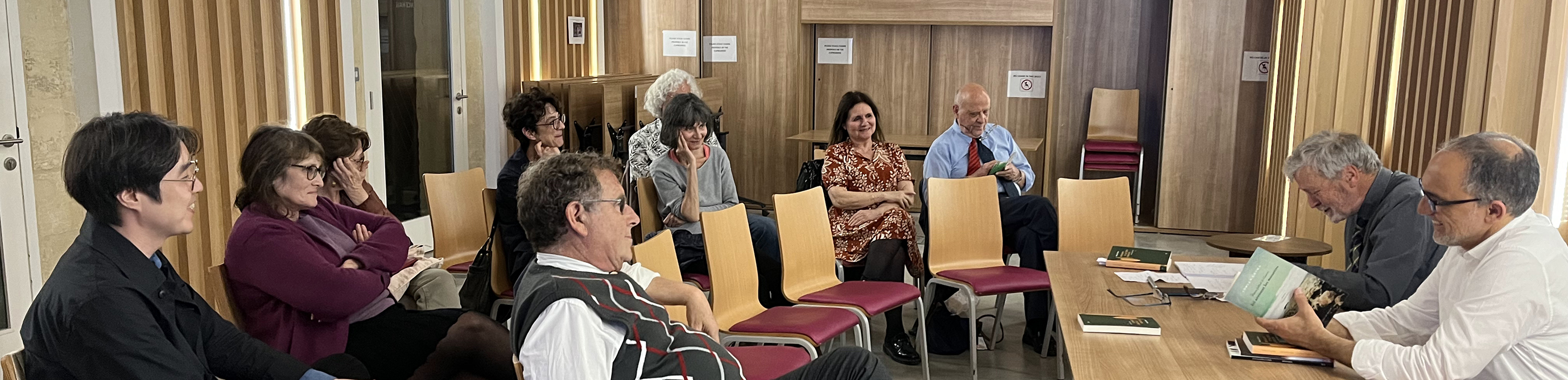
The event, conceived by Vincent Metzger, consisted of a dialogue with Maltese poet Adrian Grima, whose works will be read in French and in Maltese, as well as poetry readings in French, Spanish, Korean and Chinese by other authors. Grima’s poetry was translated into French by the poet and translator Elizabeth Grech.
This event was a joint collaboration between the Department of French, the Department of Maltese, the French Embassy in Malta and the Maltese Embassy in France, as well as the organisation ‘A partir des images’.
Les départements de Français et de Maltais de l’Université de Malte organisent une soirée poésie en français, maltais et autres langues avec Vincent Metzger, agrégé de lettres classiques, docteur ès lettres, membre de RETINA.International et auteur de textes sur la littérature et la sémiotique.
Avec la participation d’Adrian Grima, Yi-Chen Liu, Cécile Girousse, Juae Eum, François Soulages, et Richard Spiteri.
Le 6 et 7 mai, se tiendra également le colloque “Hésitation & Création” organisés conjointement par l’Université de Malte et l’Université Paris 8.
Pour assister au colloque, écrire à Dr Marilyn Mallia, chef de Département de Français à l’Université de Malte.
Questions de Vincent Metzger pour Adrian Grima
- Qu’est-ce qui fait selon vous l’unité d’un poème ? La composition (groupe de 4 vers par exemple), la conclusion (“Quand on pense être arrivé / on veut déjà partir” poème “Suspendus” Dans ici arrivent les mouettes, ) ou le hasard des suites de vers? Florence Pazzottu aurait parlé, elle aime le rugby plus que le foot!, avec cette image de “mêlée” : “cadrage et débordement”. Qu’est-ce qui, pour vous compte le plus, le cadrage, la forme d’ensemble du poème, ou le débordement, ce que provoque l’évolution du poème ?
- I have to say that I really like the rugby image, the tightness of the scrum. A poem is tight. The different parts work together very closely, and whatever happens in one element of the poem affects the other elements, both those that are close by and those that are further away. For me, what characterizes a poem is rhythm. Ultimately it’s all about rhythm, about how the sounds, the beats tear into the heart and the body, “le coeur et le corps”. Rhythm is visceral. It travels well beyond the verbal into the body. Its intensity becomes corporeal.
- Qu’est-ce pour vous que le langage poétique. A vous lire, je vous sens en accord avec la déclaration de T. S. Eliot: “poetry cannot afford to lose the contact with the changing language of common intercourse” . Vous ne craignez pas la provocation : “ils l’ont chié et tiré la chasse” (“Balkans”), vous faites apparaitre des citations du discours publicitaire, bref tout ce qui vient du dehors et traverse la poésie.
- Thanks for this reference to T. S. Eliot’s essay on the “The Music of Poetry” (1942). “Whether poetry is accentual or syllabic, rhymed or rhymeless, formal or free,” writes Eliot, “it cannot afford to lose its contact with the changing language of common intercourse.” Because it’s not the words that are poetic but the way they are used, the relations that the poem creates between them, the rhythms, the tension, the clashes of sounds, the harmonies. I love how different discourses, different “languages” can inhabit a poem, how they can enliven it. Sadly, the story I tell in “Balkans” is a true story. I suppose those who hear it immediately get the sense that this is “real” precisely because of the “raw” language that cuts through some of its lines. The Maltese poet and critic Oliver Friggieri wrote in his book L-Idea tal-Letteratura (1986) that there is no such thing as “liteerary” words but rather words that are organized in unusual, literary ways. Yes, in some of my poems the language is raw and blunt, because I feel that that is what the story I’m telling requires.
- Votre poésie est le plus souvent en relation avec des événements, qui peuvent être intime, (la cuisson du Romarin) ou collectif. Je pense ici au livre de Pedrag Matveievitch, traduit en français sous le titre Poétique de l’événement. Mais alors comment les événements sont ils mis en relation ? Il y a par exemple cette contradiction brutale et marquée d’humour noir, qui compose le quatrain “Ici arrivent les mouettes” dans le recueil éponyme (d’ailleurs le mot recueil est inexact, les deux livres publiés en français sont bien composés comme des livres et non des rassemblements hasardeux).
- There is always an intimate relationship, I suppose, between individual and collective events, between the particular and the general. I’m not sure whether this answers your question, though, Vincent. There’s a public, collective dimension to the food we consume, for example, in the intimacy of our private spaces. Food is grown somewhere, by real people who live real lives in real places. Even the private words of love we utter are borrowed from that great repository that is language…
- Enfin une question audacieuse, vous pouvez décider de ne pas y répondre : l’identité des lieux est souvent mise en doute (“pour moi la méditerranée n’existe pas” ici arrivent les mouettes .) Malte européenne,? “je me demande si je suis vraiment Maltais”. On en vient à se demander si, au fond Malte existe, et vous en parliez dans un entretien, cette île qui est au sud de Tunis, où l’on parle une langue apparentée à l’Arabe, mais où l’anglais est largement présent et la religion largement catholique. Pourrait-on dire que, pour une part Malte existe grâce à sa poésie?
- Identities are narratives. They are all about how we choose to talk about ourselves, about how we conceptualize our personality. Malta happens to be an island, so it’s impossible to ignore the physical borders of our “identity”. But how narrate that identity is highly subjective: Maltese speaking, Catholic, European, white, born on islands of Malta, straight… this is the story our literature has told for over a century about our “Malteseness.” But you could challenge every one of those categories. Being “Maltese” is so much more rich and varied than that. Postmodern Maltese literature has made us more aware of how limited our narratives of identity have been and so beautiful it is, how revealing and revelatory it is to think about being Maltese in the plural.


 adriangrima.org