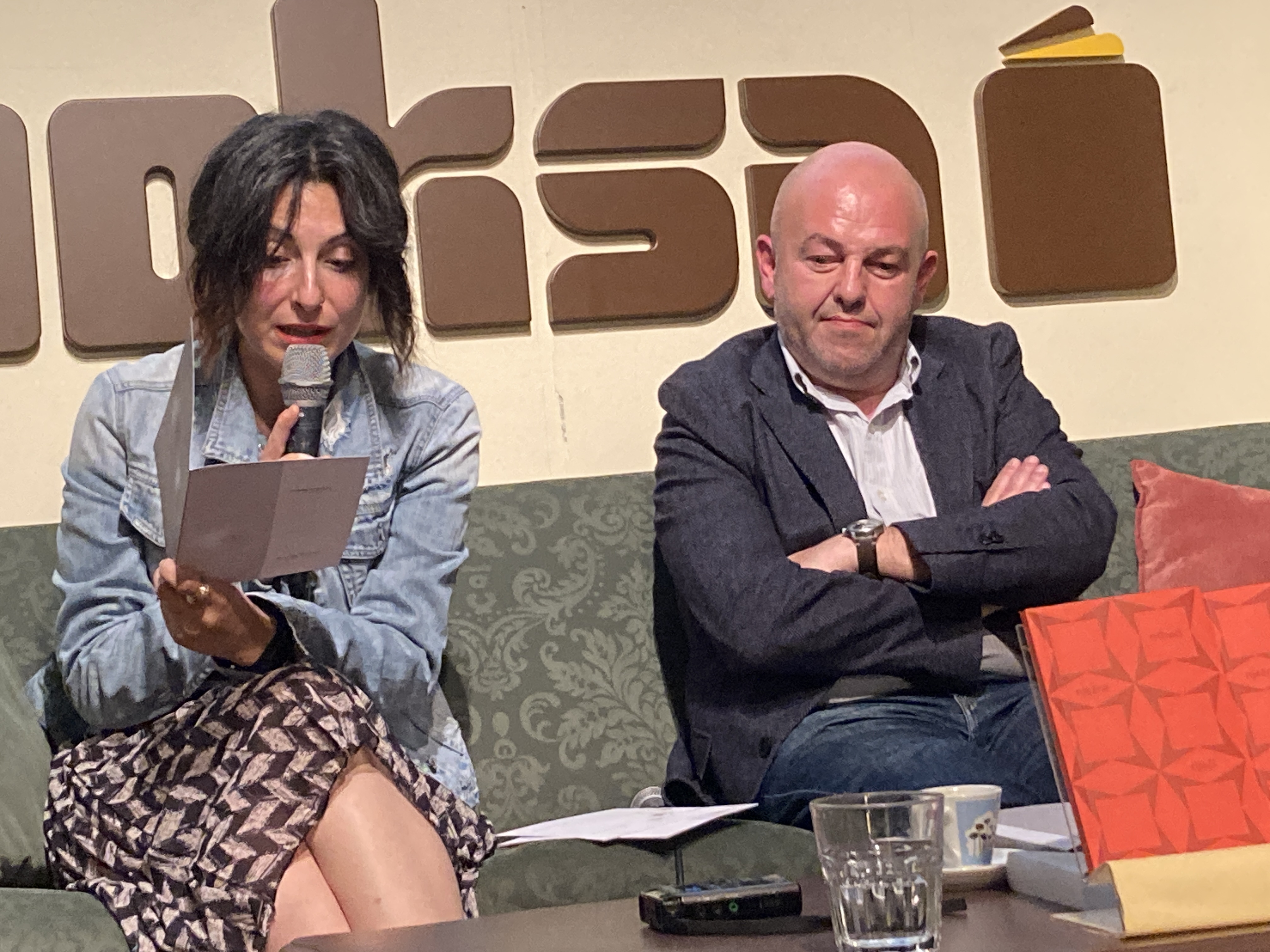
In October 2023 the Croatian association for the promotion of cultures Kulturtreger, published an anthology of contemporary Maltese poetry translated from English into Croatian. The book was launched during the 18th edition of Review of Small Literatures, a festival hosted at Booksa in its charming book lounge in the centre of Zagreb.
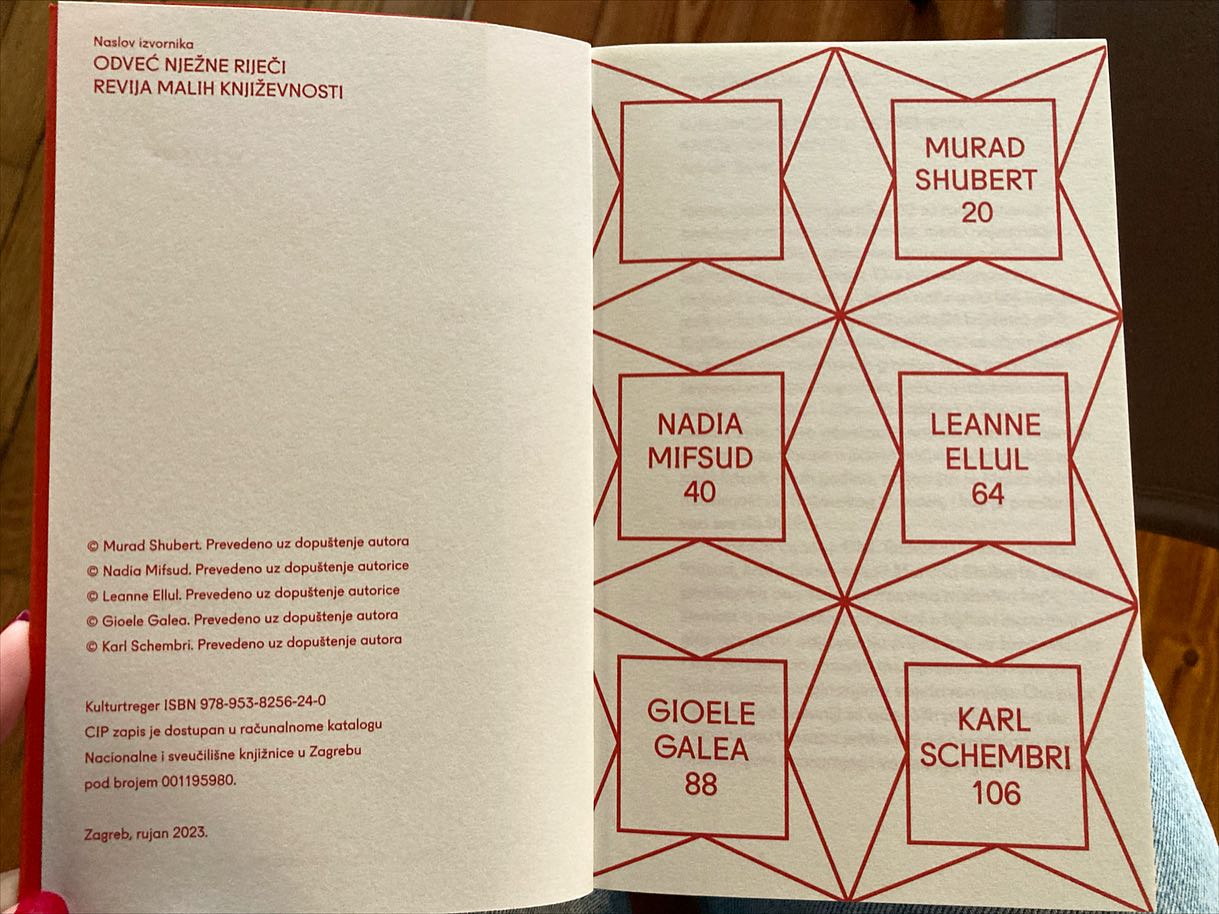
The five selected poets whose work appears in the anthology are Leanne Ellul, Gioele Galea, Nadia Mifsud, Karl Schembri, and Murad Shubert. Poets whose work had already appeared in Croatian were not considered for selection by Booksa. My presentation, “These atrophied words. A partial introduction to contemporary Maltese literature,” places this selection within the wider context of our literary history and the developments taking place in contemporary Maltese poetry. It is not a critical appraisal of the work of these poets but rather an essay that gives a non-Maltese audience an interpretation of the context within which this new poetry is being written.
Below: Read the English version of the interview with Karl Schembri that appears in the book.
Kulturtreger and Booksa
Kulturtreger was founded in 2003 for the promotion and popularization of literature and other forms of contemporary culture. Club Booksa is one of the most important programmes of Kulturtreger. Since its opening in 2004, Booksa has hosted more than 500 Croatian and foreign writers at readings, book promotions, public discussions, and many literary festivals such as the Festival of European Short Story, Festival of Latin American Literature, International Festival of Contemporary Poetry Brutal, and International Poetry Festival Goran’s Spring. Its guests included leading figures like Anne Enright, Hari Kunzru, Aleksandar Hemon, Slavenka Drakulić, Ece Temelkuran, Miljenko Jergović, Adam Bodor, Bora Ćosić, Elizabeth Strout, David Grossman, Lydie Salvayre, James Kelman, David Albahari, Daša Drndić, Laszlo Krasznahorkai, and Alberto Manguel.
The club has more than 18.000 members. Booksa is a member of the European platform of literary festivals and venues Literary Europe Live. Since 2005 it has organized its own annual festival Review of Small Literatures which presented more than 130 writers from 25 countries. In the last three years Booksa presented writers from Arab speaking countries in the Mediterranean: this was the first time that literature in Arabic was systematically translated and presented in Croatia. This anthology of Maltese poetry is the first such publication in Croatian.

These atrophied words. A partial introduction to contemporary Maltese literature
Adrian Grima
The five poets in the book whose work has been translated into Croatian are among the most exciting voices in contemporary Maltese literature. There are others. They have broken new ground in terms of what they are writing about and how they are using language to reconstruct the Maltese literary language. Literature, after all, is a constant process of reconstruction. Within the structural limits imposed on the literature of a very small island, the variety of the language of these five poets is testament to the vibrancy of the scene in Malta. The new generation has finally moved on from the content and form of the post-Independence Modernist movement that came to the fore in the late 1960s, just after Malta gained independence from the British Empire, and held sway until the 1990s.
The poetry of Leanne Ellul, Gioele Galea, Nadia Mifsud, Karl Schembri, and Murad Shubert is largely representative of what contemporary Maltese literature has become. The voices and styles are innovative and they respond to the rapidly changing world ushered in by the new millennium and the increasingly globalized imaginaries of the minority world. These writers are more aware than those who preceded them of their positionality as creators of a language that is constantly struggling to narrate an inner and outer world that is significantly more complex, more nuanced than before. In “But now?,” for example, Gioele Galea writes about how “The more I / stripped off your words / the more beautiful you seemed to me, / my soul.” It is a language that can feel so limited, so constrained, so inadequate, but equally so lively, so malleable, so resourceful.
Maltese and other imaginaries
The language of Maltese literature is predominantly Maltese which, ever since Independence in 1964, has been the national language and one of the three official languages, the others being English and Maltese Sign Language. In 2004 it became the first official language of the European Union of Arabic origin. For many Maltese, the national language is the first thing that comes to mind when they search for an expression of their collective identity. In recent years, the large presence of foreign workers and residents, who now make up some 25% of the population, has had an impact on the demographics of this small island state and the dominant status of Maltese as the language of the large majority of people. Malta, with its very high population density of around half a million people living in just 320 km2, is today more linguistically and culturally diverse than it has been in living memory, and in a state of constant evolution. This is partly reflected in the individual stories of the five poets whose work appears in this book.

This evolving, multilingual scenario might suggest that Maltese writers are moving away from their native language in order to embrace English, but this does not seem to be the case. Today there are possibly more young Maltese people, or of Maltese origin, in Malta and abroad, writing in English, and eager to be part of the Maltese literary scene. But the more significant phenomenon, I would say, is that of Maltese writers living abroad, in London, Paris, Lyons, Nairobi, Brussels, Luxembourg, Melbourne, Sydney, and Toronto, who could be writing in their adopted languages, English, French, Arabic, or Italian, but have chosen to continue to write, or even to start writing, in Maltese. Despite having pursued successful personal and professional lives elsewhere, the Maltese literary scene is where they feel they belong as writers. Perhaps one of the reasons for their connection with literary Maltese is that in the small but internationally well-connected scene of Malta their voices can be more readily heard. They can be protagonists and represent Malta and its literature with their work at international events.
Both Nadia Mifsud, who lives and works in Lyon, and Karl Schembri, who has lived in the Occupied West Bank, Gaza, and Amman, and now lives in Nairobi, have been away for many years and they have built successful careers away from their country of birth. But they keep in touch, both virtually and by visiting regularly. Mifsud is also one of the key members of the team of volunteers that organizes the annual independent Malta Mediterranean Literature Festival. Although he has returned to Malta, Fra Gioele Galea lived for many years in a monastery in Italy and continued to write his contemplative poetry in Maltese.
The Moroccan-Maltese poet and short story writer Murad Shubert, like the Jordanian-born Palestinian-Maltese writer Walid Nabhan and the Russian-Maltese poet Yana Psaila, was not born in Malta but Maltese has become his main literary language. And while he does a good deal of literary translation into his mother tongue, he is making a name for himself as a writer of literature in Maltese. He is inspired primarily by an Arabic literary tradition with which most of us Maltese writers have a largely tenuous connection, writers like Mohammed Choukri, Mahmoud Darwish, Ghassan Kanafani, Salim Barakat, and Amal Donkol. He is an avid reader of non-Arabic writers like Wisława Szymborska and of contemporary Maltese literature: his translations into Arabic of works by Immanuel Mifsud, Clare Azzopardi, and Fra Gioele have allowed our literature to share shelf space in libraries and bookstores with some of the most lyrical and subversive voices of Arabic literature.
Shubert’s minimalist poetry is intellectually and emotionally intense and full of cosmic irony. His “stories” are like flesh tearing bullets: there is very little room for compromise. But these poems are profoundly compassionate towards those who suffer in the silence and indifference of a distracted world. The only thing that can give any sort of meaning to our existence is love. There are glimpses of this in his poetry, but it is always unsettled and fleeting.
The language Shubert now writes in is not far removed from his native North African Arabic. Maltese is over a thousand years old. It’s origins lie in the occupation of the islands by the Arabs who arrived from Sicily in 870 CE but were originally from North Africa, presumably what is today Tunisia. They spoke an Arabic that largely reflected that provenance. It is said that they took away the few thousand inhabitants of our islands with them to Sicily and only returned to stay in the mid-eleventh century. Their Arabic was therefore already influenced by the Romance language of Sicily. In the following centuries, various European peoples gained control over Malta and brought their languages with them but the Maltese continued to speak their local brand of Arabic which eventually developed into a unique Semitic variety, written in Latin script, with strong Romance and eventually English influences.
Over the centuries, Maltese continued to thrive as the spoken language of the people alongside a privileged official European language, especially Sicilian and Italian. Throughout the nineteenth and first decades of the twentieth century, Italian was the language of administration, religion,education, culture, and established literature. Maltese as a written language started to emerge in the early nineteenth century, especially after the people obtained press freedom and the right to publish all sorts of books and printed matter in 1839. The urge to write literature in Maltese, the language of the people, was facilitated by the presence in Malta of Italian political and cultural exiles from the Risorgimento, including well-known novelists and poets, who spread the ideals of the nationalist Romantic movement. As with other “national” literatures that were born in Europe during this period, the emergence of literature in Maltese was intimately tied to the nationalist ideals and mythologies of the Romantics and this legacy continued to be felt even in the work of the generation that revolutionized Maltese literature, the so-called Modernists, that breathed new life into the tired nationalist narrative that accompanied the people’s struggle for Independence.
Breaking the Mold
Stylistically, one of the most important innovations of the Modernist movement was the way they opened their literature to the language spoken in everyday life by common people, especially the younger generation. They discarded many of the fossilized literary forms, vocabulary, turns of phrases, and syntax that had dominated the work of the Romantics, with their prejudice against “impure” words and expressions of non-Arabic origin. In effect, everyday modern Maltese still retained a very strong element of Arabic in its grammar, that is in its morphology and syntax, and in many of its most commonly used words, but there was also a strong Sicilian, Italian and English influence in its vocabulary and, increasingly, in its idioms. The words and phrases of non-Arabic origin connected post-Independence Malta to modernity, to the Europe and “America” which the young, educated Maltese looked to for inspiration, and the Modernists were eager to use them everywhere. It was liberating. But the accent on the nation and on a rather fixed notion of “national identity” remained.
The new voices of the 1960s were highly critical of the mythologization of the past, partly because it implied an untruthful picture of the present and refused to acknowledge modernity. They started to liberate the body and the mind from the posturing and hypocrisies of the puritanical code of sexual behaviour promoted by the Romantics. With Malta still trying to come to terms with Independence and the precariousness of its economic situation, the nationalist narrative, which was central in political discourse, continued to hold sway in culture and the arts. When narrating the community and that very Romantic construct of the nation, Modernist Maltese literature continued to engage with the nationalist narrative proposed by the Romantics, with patriarchy, the Catholic faith, heterosexuality, the nuclear family, European and Christian heritage, the essential superiority of the rural over the urban, and the local over the foreign, as mainstays. This new literature wanted to renew the model, to offer a more honest, twentieth century appraisal, to connect with the outside world, especially with the so-called Western world, and with its mass culture, but not to do away with the very foundations of the Romantic interpretation of “what makes us Maltese.”
The “post-Modern” poetry, for want of a better word, that appears in this new anthology, owes much to the stylistic and thematic revolution brought about by the young, post-war generation of writers of the Modernist movement. But it moves beyond the national and nationalist narrative to a territory shaped by the body and the experience of the individual in a very complex world. By freeing themselves from the code of conduct and discipline of the Catholic Church and the full force of patriarchy, the often secular writers of the new millennium, partly inspired by writers and cultural activists abroad, took the liberation of the body and mind to a whole new level.
These are “Maltese” writers writing literature in Maltese but their universe is no longer framed primarily by their islands and by the native-born community. It is no longer framed by the need to narrate the nation. For a literature whose origins lie squarely in the world of Romantic nationalism, this most recent “iteration” of our literature appears to challenge the very foundations of what it is to write in Maltese. The development of literary translation, with the backing of national and European institutions, has opened our literature more than ever to the world while retaining the unique character afforded by writing in the vernacular. The new linguistic scenario in the Maltese Islands allows for more literary translation by native speakers of Maltese with varied ethnic backgrounds, and speakers of Maltese as an adopted language.
Another significant feature of the twenty-first century scene is the emergence of the many different voices of women and LGBTIQ writers that have shaken Maltese literature to the core. Their work challenges some of the patriarchal norms that have dominated Maltese literature from its inception as a standard cultural form in the mid-nineteenth century. The connections with writers abroad facilitated by, but not limited to, the networks fostered by the Malta Mediterranean Literature Festival run by Inizjamed, an independent cultural organization set up in 1998, have greatly contributed to the empowerment of these voices. All the writers in this anthology have featured prominently in this Festival that started in 2006 in collaboration with the European network Literature Across Frontiers. This anthology is itself a result of these same networks of partnership and collaboration which were greatly facilitated and enhanced by the internet revolution that on a clutch of tiny islands on the periphery of Europe, south of Tunis and Algiers, suddenly compressed time and space.
Contested memories, shared futures
In Maltese, the standard word for “our ancestors” is “missirijietna,” literally “our fathers;” we also have “antenati,” literally “ancestors,” but it has less of a pull. “Missirijietna” appears everywhere in Maltese literature, not least in the work of our national poet (and priest), Dun Karm Psaila, whose poetry represents Malta’s foremost Romantic expression of national identity. Although Malta is a revered mother (perhaps more mythologized than revered), women feature at best as secondary figures in the national imaginary promoted by this literature. Alternative female genealogies come to the fore in Nadia Mifsud’s poetry, as in that of other women writers like Simone Galea, a leading contemporary writer and feminist philosopher. In “this is how you love me best,” translated by Albert Gatt, the lyrical voice of the mother addresses her daughter:
if you look closely, child,
nadia mifsud
you might just find
tiny specks of those who came before me
lurking in the depths of my eyes
search some more and you’ll see how
tucked away on my temples
there are the varicoloured fables
that my nan used to
weave for me
every night
The tenderness of the moment need not distract us from the political force of the poet’s words and the assertiveness of her stance. The child needs to look “closely” because women have been written out of their own story. It is only “tiny specks” of that story that can be gleaned, but there they are, as stubborn as the memory that refuses to let them be ignored. This story, the life stories of individual women, is represented by the “varicoloured fables” (“il-ħrejjef kull kulur” in the original, literally “fables of every colour”) that her grandmother used to tell her, that conscious, subversive act of individual women taking hold of their own narratives. It’s a genealogy that leads all the way back to her great grandmother and beyond. And Mifsud has every intention to empower her own daughter to tell her own story too. No reticence. No hiding. The poem itself makes sure of that.
The poetry of Leanne Ellul and Gioele Galea is testament to the prominence of the body and the individual experiences of a human being interacting with the very unique physical and emotive spaces they find themselves in. For Ellul the body is the universe, not because she recoiled from the physical world but precisely the opposite, because she is fully engaged with it, body and mind, physically, emotionally, intellectually. This is not a poetry of observation. It’s a poetry of immersion, of total engagement, of embodiment, actually. It finds its expression in the way she takes the words and expressions apart and reassembles and reconstructs not only the language but, more importantly, the world she is dealing with, a new world, previously “unexperienced” and untold. Memories are just as physical and present as the body itself. In “the atrophy of wounds,” translated into English by Albert Gatt,
every wound in my body I’ve named a different name
leanne ellul
every wound happened once upon a time and not another
obvious as these excommunicated words disjointed sentences
The poet’s struggle with body is also a struggle with words. With embodiment.
In Gioele Galea’s intensely contemplative poetry, the physical world, in close proximity, is also no longer observed but becomes an integral part of the poet’s internal world, his body even. In the Maltese original, “(this) stone” is “intimate,” as “essential” as “pain” which “you alone touch” and “you alone can fathom.”
Intimu dal-ġebel.
gioele galea
Essenzjali.
Daqs l-uġigħ
li inti waħdek tmiss
u waħdek tiżen.
In the translation by the Maltese English-language poet Abigail Ardelle Zammit,
Stone is intimacy,
gioele galea
is necessity.
Is ache and pain
which self alone
can fathom.
As in Zammit’s translation for the Malta Mediterranean Literature Festival (2016) which appears in this book, the crucial word “ġebel” in the title is a collective noun, “stone,” denoting the type of material. So Galea is identifying with “stone,” rather than with a particular stone. The demonstrative pronoun “dal-,” “this,” only makes the identification more immediate, more urgent. Galea’s intimate poetic universe is both infinitely smaller and larger than that of his predecessors.
Perhaps the most overtly political work of these five poets is that of Karl Schembri. As a freethinker who jealously guards his independence, but also as a concerned citizen, he is troubled and angered by many of the moral issues that Maltese society is facing, or choosing to ignore: from nationalist mythologies to religious fanaticism, from the excesses of neoliberal economics and ideology to the inhumane and unjust treatment of refugees and migrants; from the marginalization of the disenfranchised to the plundering of natural resources. But in his poetry, with its beautiful metaphors and seductive rhythms, the voice is that of a citizen of the world, “a luggage-carrying citizen” in Albert Gatt’s version of “Biljett Miftuħ” (“Open Ticket”). His rousing manifesto of cosmopolitanism, that denounces the walls and burocracies that imprison us, especially those among us who are not “authorized,” is both Maltese and cosmopolitan in its outlook. His “passport bearing the faces of the nations I have loved” reminds me of Antoine Cassar’s iconic long poem in Maltese Passaport from 2009, a rousing anti-passport which argues passionately and poetically in favour of a world without the kind of borders that are created by human beings to snuff out the life of other human beings. “What colour are your daughter’s eyes?” asks the immigration officer, the guardian of the minority world on the frontline, that border between the privileges of our gated community and the underground cells of our inhumanity. The question is the answer.
These atrophied words
In Leanne Ellul’s “the atrophy of wounds, or until I feel the pain inside,” the persona encourages the anonymous addressee, possibly both the reader and herself, to “keep mouthing these atrophied words and you might give them form.” To atrophy, the verb, is to waste away, especially as a result of the degeneration of cells. The original Maltese version of this line uses the unusual adjective “atrofikat” to describe “il-kliem,” the collective noun for “words” so typical of the Arabic morphological structure of Maltese. Her line brings to mind the struggle of Maltese poetry, and poetry in general, to mouth experience, the need to commission new words, to reshape the language. It’s a constant process of construction, of rebirth.
In The Life of Texts (2019), Ann Rigney reminds us that “literature is a multidimensional and dynamic cultural phenomenon” (39), because “poems and all sorts of other texts ‘live’ in society” (13). Poems are not artefacts that inhabit some kind of cultural space estranged from time and space. They are not sealed in some vacuum-packed “universal” dimension. They are written by real people in real time and space. And they come alive in the consciousness of the individuals who read them in their image and likeness. Every time a poem is read it becomes; every time it happens all over again. Differently. Inevitably, what appears in this brief introduction, this attempt to introduce the Maltese literary context and to explain this selection, is both subjective and contingent. These poets, these poems offer far more than can be captured in a brief introduction, or even a long one, for that matter. Poetry, and literature in general, is about the refusal to be captured. The “reinvention” of these poems in Croatian, in a Croatian literary tradition, will no doubt give them a new life and I’m eager to know what they will “sound” like. How they will inhabit their new space and time.
Gozo, September 2023
An Interview with Leanne Ellul by Booksa
Read the English version of the interview with Leanne Ellul here.
An Interview with Karl Schembri by Booksa

In the anthology, we read five of your poems (if we count the “Maltese Triptych” as one) translated into Croatian. Can you tell us more about them and the context of how they came about?
The poem Where’d you leave your bicycle when you fled? is my latest poem in this anthology and I’m actually building a collection of poems in the voices of refugees and displaced people I’ve met through my work over the last 15 years or so.

The poem is inspired by a photo I took in Eastern Ghouta, outside Damascus, Syria, on June 4, 2018. This was the site of a long and brutal siege, which cut off everyone who lived there from essential supplies and from the rest of the world for five full years. That day I was in a school, half destroyed by bombs, where I met children who were returning to class after years of war and siege. The excitement on their faces, now that they could come back to school, was in total contrast to the destruction around them. At one point, between one interview and another, I went outside to take again all the pictures of the destruction around me. In front of me I see a lonely man walking by bicycle, in a street full of houses with no facades – it’s like someone went by with a knife and cut them, like you cut a cake. In those houses you could see what was left of the private property of those who lived, and maybe even died, there. I took a few photos and went back inside to interview the kids. The image of the man with the bicycle stayed in my mind for many years since I processed it and it was published. When the war broke out over Ukraine, it came back to my mind with more force. What became of this nameless neighbor? Where did he go by bike, the little treasure left for him in the middle of this devastation?
Quarantine – Covid days – is an existential lament about our human condition during the days of Covid-19. People were born and died anonymously – not even funerals were permitted. The days themselves became anonymous – one day indistinguishable from any other as we waited for this global pandemic to calm down. I found it very humbling, how one virus could bring us all to a halt, like we’ve never seen in our lifetime, although I doubt that we’ve learned anything that makes us better humans.
Open ticket is an old poem of mine that I wrote while I was travelling and it tells of my vision of life and of the world, where the sacred and profane become indistinguishable, together with the spectacular and the mundane. It is also a poem of friendship that comes with travelling and getting to know other people. I mention some real people I met in real life – like a Japanese friend of mine who had his bicycle stolen, and a Palestinian family whose son was killed.
The Maltese Triptych is a bit of a satirical assault on our shallow cultural icons in popular mentality. Much of our popular cultural identity in Malta comes out through the way we deal with tourists, how we celebrate village feasts – and to an extent that I think is now waning – through the traditional marriage arrangements.
The void is really a poem about depression and the cruelty of a world that goes on when yours seems to have stopped.
You have a truly impressive journalistic career and biography. When and how did literature “happen”? Was there something that journalistic forms didn’t manage to convey or communicate? Or did it all start with literature?
I’ve always had a keen interest in writing – from reporting to creating my own world – and I learnt much from journalism that is so fundamental to the craft of writing: attention to details, concision, shaping a story and a lot more.
My creative writing feeds a lot off my journalism and humanitarian work, and at best I think it is a process of distilling the raw stories I come across into something purer. Literature allows me to confront the voices of the people I meet and relate to them on the human level. Often in my work, the urgency to get these people’s stories out in the media takes priority over any other consideration. There is not much time to process what I think when I am running against time to get their stories out, while there is still media interest, while for once, someone cares to listen.
When their stories are told, in one way or another, I can begin to process what is left bombarding my mind from their voices. Their voices come to haunt me; I can hear them in their essential purity, beyond the facts and figures and percentages of suffering. That’s how most of my literary writing starts, particularly poetry, as a process of dealing with those voices.
The journalistic vocation, I would say, is also visible in your poems, which are very topical and current in terms of subject matter and motif, and at times even reporting, full of rhetorical questions. Can you say something more about how you combine journalistic and literary, poetic work? Does one influence the other in terms of subject matter, but also expression and style?
There is an old tradition of writers who I humbly look up to, from George Orwell to Ernest Hemingway, to Gabriel Garcia Marquez and Jose Saramago – who were also committed journalists. If you take journalism as a mission or vocation, that puts you on the frontline of the battles for freedom of speech, against censorship and propaganda. I’m also very privileged that journalism and the media work I do now with refugees have made me encounter people from all sorts of life facing some extreme adversity: war, famine, drought, and all sorts of catastrophes. War in particular brings out the best and the worst out of humans. It’s inevitable for me that my literary work is going to feed from those experiences and encounters, in different ways. It’s very obvious in most of my poetry, but also my earlier novels and short stories were very much influenced in style and voice from working as a young journalist. My first book of short stories called Taħt il-Kappa tax-Xemx (Under the Sun) first came out 21 years ago. It’s all narrated by a young frustrated journalist who cannot keep up with all that’s happening around him.
Beyond my writing, journalists and authors are brothers and sisters in arms in our battle for freedom of speech, which is why I am an executive committee member of PEN Malta.
In your poems prevail people from the margins of society, refugees, migrants, illegals etc., whom you portray with great warmth. Why is it important to show such perspectives and voices in literature? Do you think that literature can be a tool that will shake social injustice?
I firmly believe that literature is what we need when facts stop telling us the truth. I could flood you with facts, statistics, documented human rights abuses, tons of files about, say, Palestine, and you might still feel nothing, if not persist in denying Palestinians their rights. I’ll tell you it’s Apartheid, you’ll say it’s the Jews’ right to wipe out Palestinians. A good novel, or poem, would make you feel something: sympathy, antipathy, outrage, love, disgust; great literature puts you in other people’s shoes, they make you face their own dilemmas that you may have never felt in your life. Whether it’s refugees, migrants, or serial killers and cannibals, it doesn’t really matter as long as it’s authentic, that means it’s uninhibited in its exploration of the subject matter. I’m as interested to read a novel with the insight of a paedophile as much as I’m interested in reading a refugee’s odyssey, because great literature is also about opening doors to realities we are not part of.
Of course, as an individual, I make my own choices, and my work has a huge impact on what I write about, first as a journalist and more recently as a humanitarian worker with a job to communicate about refugees, displaced people and people in need of protection. I have been privileged and lucky as a journalist and as an aid worker to come in touch with a variety of people across society, but with a greater force among the silenced, the neglected, the marginalised and excluded. I always felt that, fundamentally, whoever is silenced by someone, needs to be heard, whether I agree with him or not. As a journalist, I lived by the motto that ‘news is what somebody, somewhere, wants to suppress’. I think that informs my overall morality and prioritisation of values.
I previously mentioned that your poetry is topical and current, you don’t hesitate to write about important social and political topics of inequality, refugee issues, borders, religion, COVID, and exactly in a way that I imagine a good socially engaged contemporary poetry. Today, unfortunately, authors often shy away from more explicit political and social engagement due to the fear of “programmaticity”, as if engagement and good literature are mutually exclusive. How do you comment on that?
Good literature is about opening doors to realities beyond our immediate ones, or presenting our own realities through different lenses. Whether it’s through the character of a Nazi general, a battered housewife, a drug addict or an ISIS militant, the question for me is not the subject matter, but the authenticity with which it is dealt with. And by that I mean the uninhibited freedom to explore the subject matter, at its best moments and in its darkest episodes, in its most humane and in its most monstrous.
The idea that one should shy away from politically engaged content to me is incomprehensible, when politics shapes our lives, for better or for worse. Whether we can travel or not, and where and how, is a matter of politics. Who is rescued at sea, and who is left to drown, is a matter of politics. Who deserves our citizenship and who deserves deportation is a question of politics. Whether you have a pension or not is a question of politics. How can literature not deal with all this? It’s been dealing with it from Homer to Dante to Dickens, and it’s doing it perfectly now with the authors who are authentic to themselves. Any other consideration of how an author might be judged – beyond the question of authenticity – is entirely superfluous and anti-literature, that is, goes against the idea of the free-spirited author exploring the world through language with no concern except for his own creation.
The “Maltese Triptych” is very interesting to me; here you present Malta through three poems: about maltese party, marriage and tourism, all of the poems being quite intense and critical, even caricatural. Why these three topics (party, marriage and tourism) and not some others? Are these key terms for Malta today?
I wrote the Triptych some 15 years ago, and yet I still feel the idea of the Maltese ‘festa’ – the village church feast in honour of some saint – together with the idea of what makes us Maltese, in all its stereotypes and caricatures, is still prevalent among many in Malta today. You are right in sensing the intensely critical and caricatural in these poems – for me they were easy targets made of the Maltese archetype, a satire of what we think we are, as opposed to how we look in the mirror, or as I see our own representation in the mirror, because ultimately this is my own subjective lens. I see the Maltese archetype as servile, mediocre, submitting to pomposity and petty power plays for petty parochial recognition, bowing to ghastly statues of hideously tortured martyrs in public while reveling in amorality elsewhere. Catholic Malta is also an amoral Malta that boasts about its corruption, sells passports to war criminals, and has a former prime minister – beloved by half of the country and still out at large – who was gifted some vintage wine for his birthday party by the man accused with the assassination of journalist Daphne Caruana Galizia. You can say that the Triptych is a caricature of the shallowness of our values and what we believe makes us unique.

 adriangrima.org