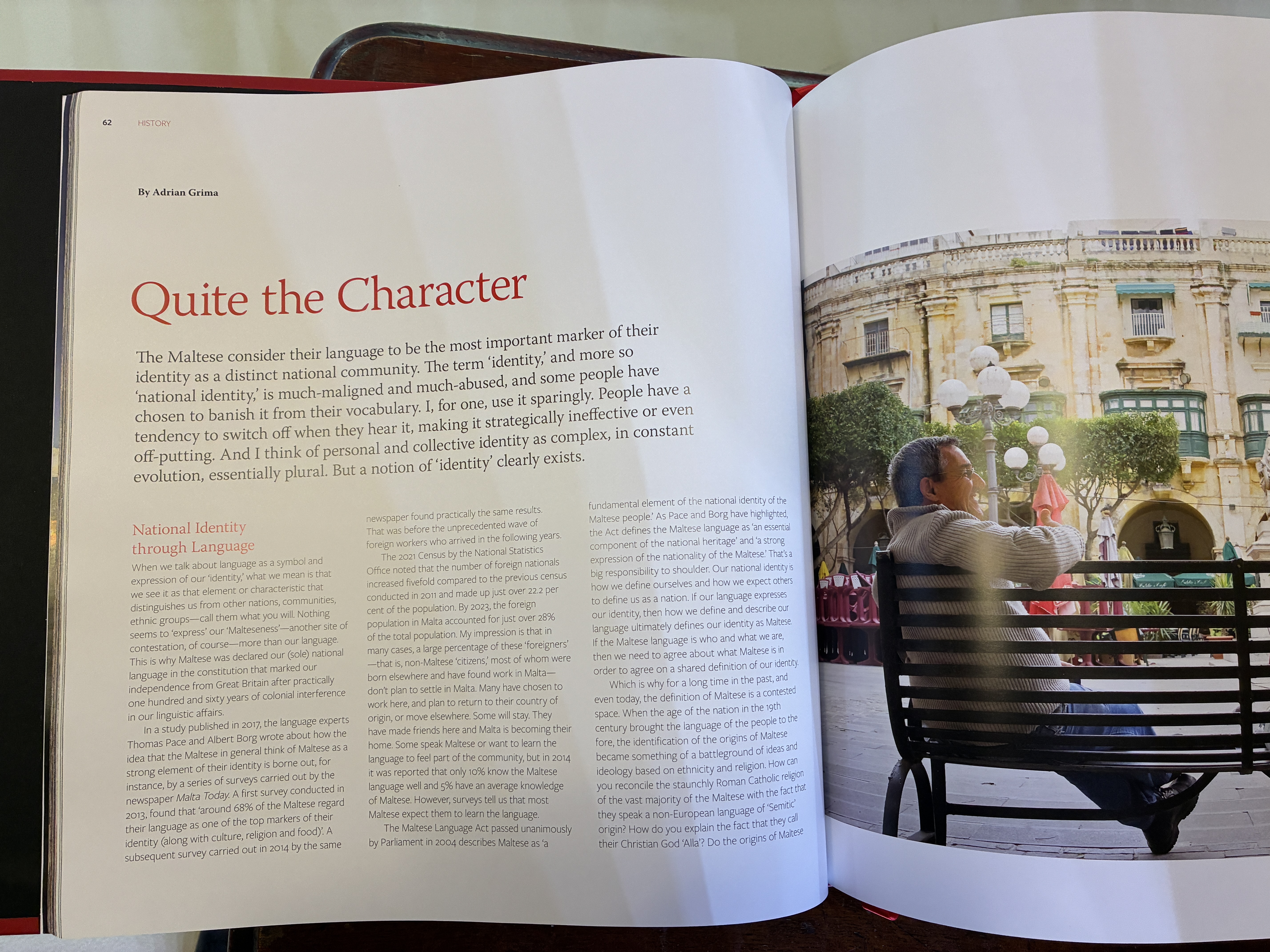
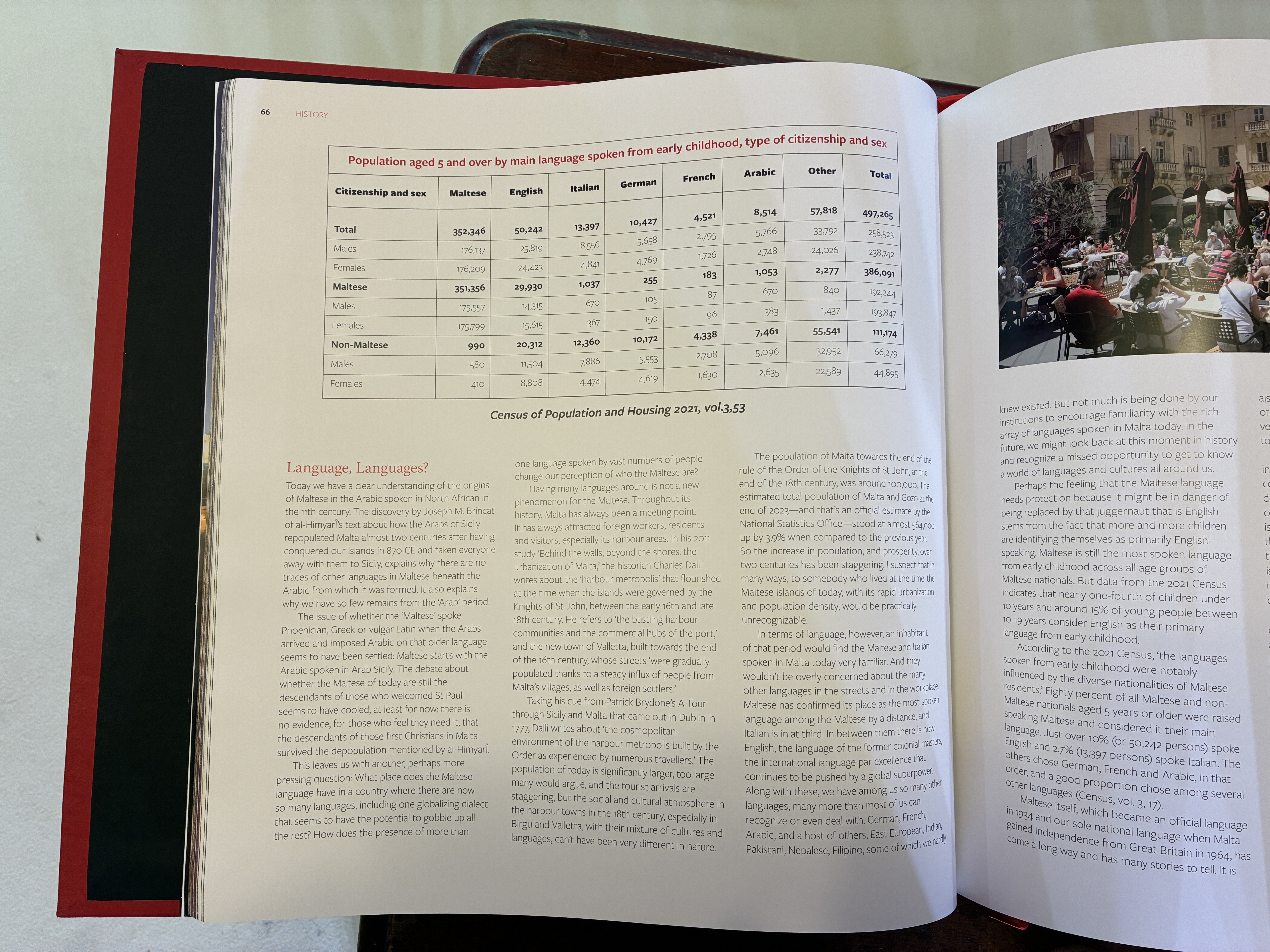
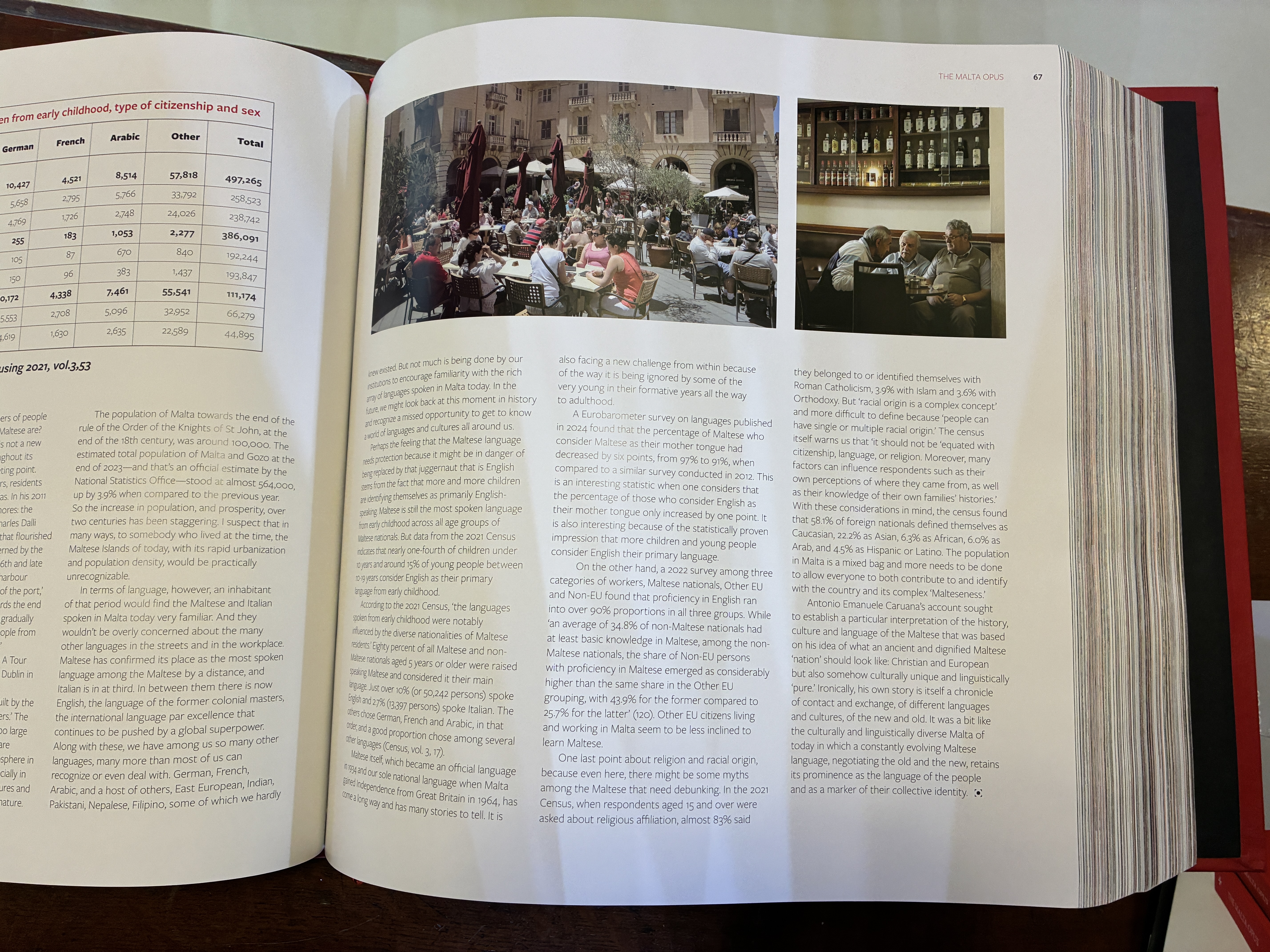
My chapter about the use and pereptions of the Maltese language, “Quite the Character,” commissioned by Prof. Victor Grech as editor, has been included in the volume The Malta Opus (2025) by the luxury international book publisher Opus. The referenced 4000-word study discusses, and problematizes, the role of Maltese as the principal marker of Maltese “identity” and refers to a number of censuses and studies about the current state of Maltese and other languages in Malta.
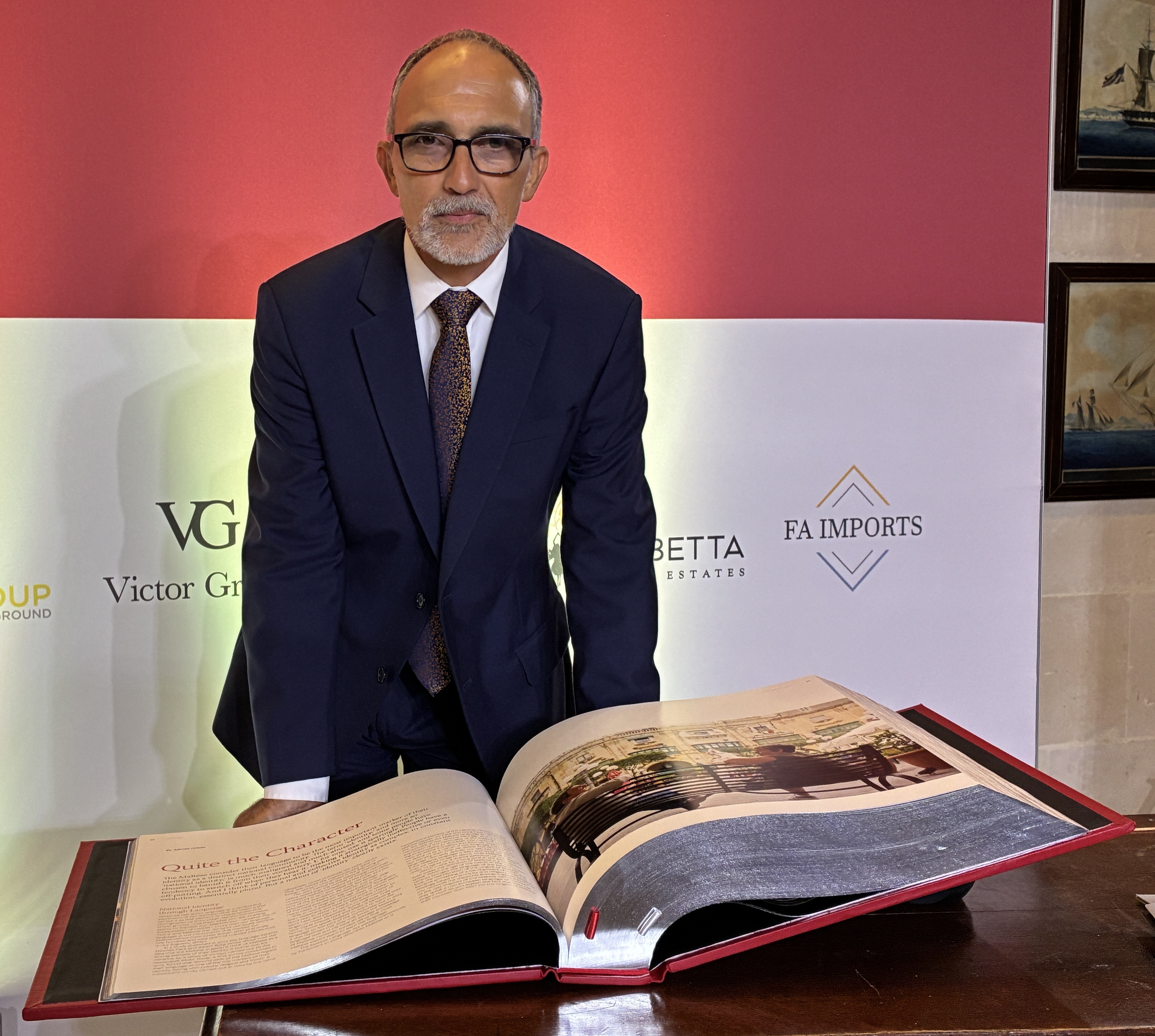
The large-format, hard-bound book weighs 38kg and aims to tell the story of Malta, its culture, history and identity. This lavish publication was launched at the Malta Maritime Museum in Birgu on Thursday 18 September 2025 by Opus managing director Karl Fowler, Opus Malta director Daniel Cuschieri, and Victor Grech as the executive editor of The Malta Opus.
In November 2024, when the project was first announced, The Times had reported that “three editions of the luxury publication will be printed, with a 50-page digital version also made available online for free.” My chapter on Maltese appears in the large printed version.
Antonio Emanuele Caruana and Myths about Maltese
In the central part of my article I explore the cultural significance of the nature and history of the Maltese language by looking at the story of a much-travelled, enterprising Maltese businessman, ‘Orientalist’, and philologist called Antonio Emanuele Caruana (1839-1907) who published a book in 1896 in which he detailed his views, as someone who studied Semitic languages, on the origins of the Maltese language, Sull’origine della lingua maltese. Studio storico, etnografico e filologico.
This was based on a series of articles that he had published in the Italian-language newspaper Il Portafoglio Maltese in 1894 and 1895. Italian was very much the language of culture and scholarship at the time, so choosing to write in Italian was not, in and of itself, particularly telling. Caruana described his book as a study steeped in history, ethnography, the systematic study and description of peoples, societies, and cultures, and philology, that deals with the structure, historical development, and relationships of languages or language families.
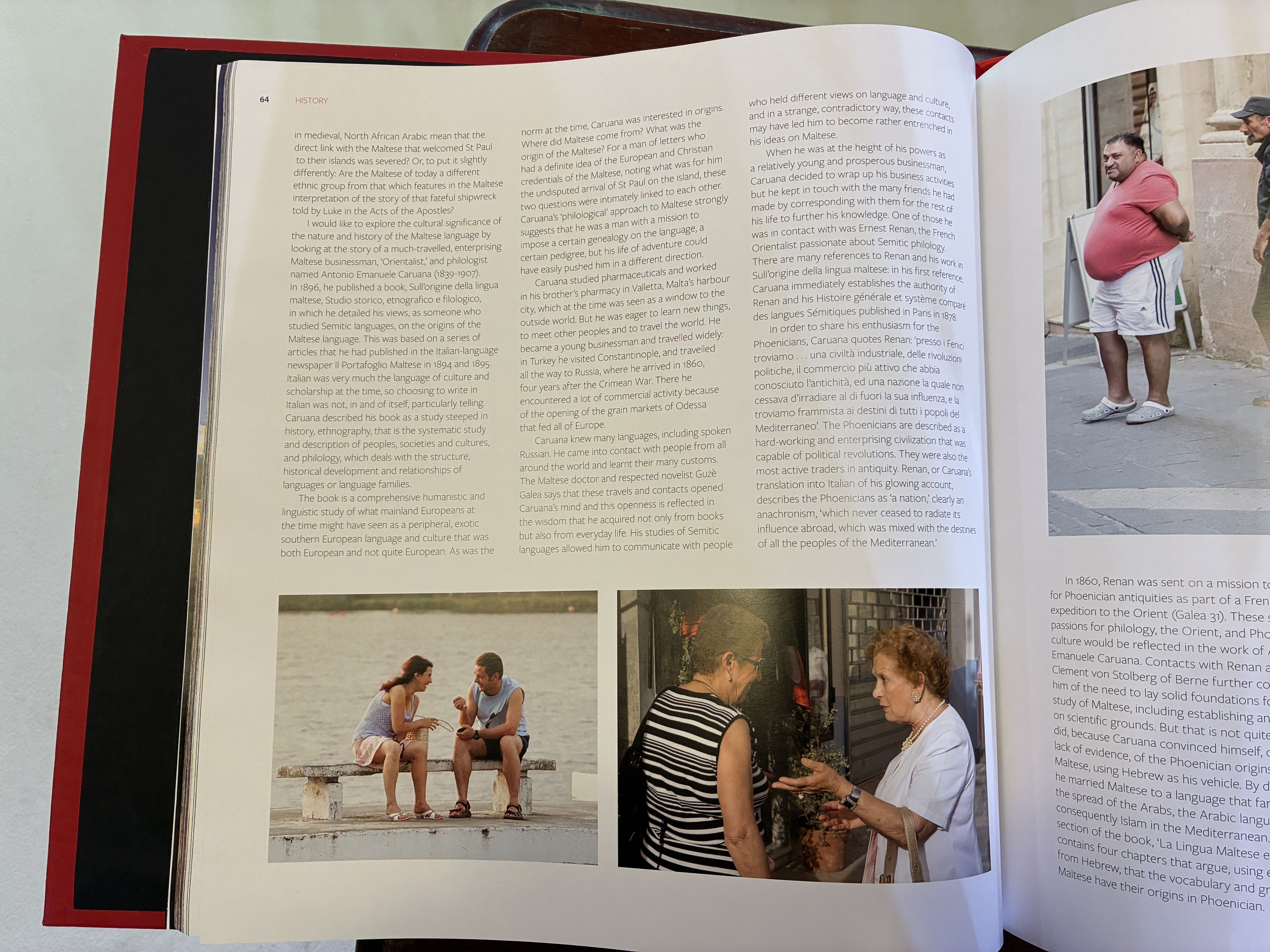
The book is a comprehensive humanistic and linguistic study of what mainland Europeans at the time might have seen as a peripheral, exotic southern European language and culture that was both European and not quite European. As was the norm at the time, Caruana was interested in origins. Where did Maltese come from? Where did the Maltese come from? For a man of letters who had a definite idea of the European and Christian credentials of the Maltese, noting what was for him the undisputed arrival of St Paul, these two questions were intimately linked to each other. Caruana’s ‘philological’ account of Maltese strongly suggests that he was a man with a mission to impose a certain genealogy on the language, a certain pedigree, but his life of adventure could have easily pushed him in a different direction.
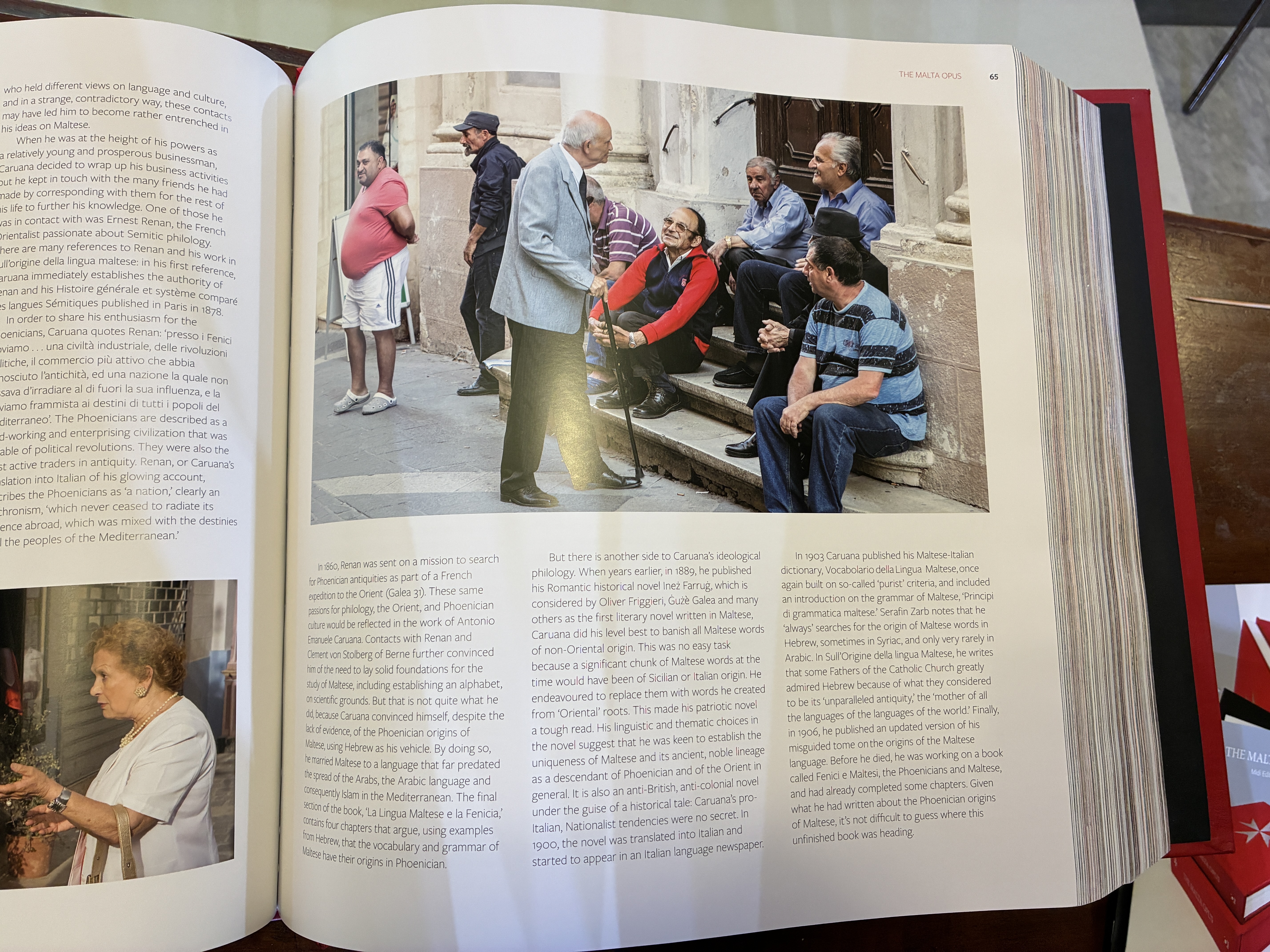
When years earlier, in 1889, he published his Romantic historical novel Ineż Farruġ, which is considered by many the first literary novel written in Maltese, Caruana did his level best to banish all Maltese words of non-Oriental origin. This was no mean task because a significant chunk of Maltese words at the time would have been of Sicilian or Italian origin, which he replaced with words he created from ‘Oriental’ roots. This made his patriotic novel a tough read. The linguistic and thematic choices he made in the novel suggest that the author was keen to establish the uniqueness of Maltese and its ancient, noble lineage as a descendant of Phoenician, and of the Orient in general. It is also an anti-British, anti-colonial novel under the guise of a historical tale: Caruana’s pro-Italian, Nationalist tendencies were known. In 1900 it was translated into Italian and started to appear in an Italian language newspaper in Malta.
In 1903 Caruana published his Maltese Italian dictionary, Vocabolario della Lingua Maltese, once again built on so-called ‘Purist’ criteria, and included an introduction on the grammar of Maltese, ‘Principi di grammatica maltese’. Writing in 1926, Serafin M. Zarb notes that he ‘always’ searches for the origin of Maltese words in Hebrew, sometimes in Syriac, and only very rarely in Arabic. In Sull’Origine della Lingua Maltese Caruana writes that some Fathers of the Catholic Church greatly admired Hebrew because what they considered to be its ‘unparalleled antiquity’, the ‘mother of all the languages of the languages of the world’. Finally, in 1906, he published an updated version of his misguided tome on the origins of the Maltese language. Before he died he was working on a book called Fenici e Maltesi, Phoenicians and Maltese, and had already completed some chapters. Given what he had written about the origins of Maltese in Phoenician, it’s not difficult to guess where this unfinished book was heading.
This write-up includes excerpts from the published chapter itself.

 adriangrima.org